
AI Employees Are Coming: What Claude Tells Us About the Future of Work?

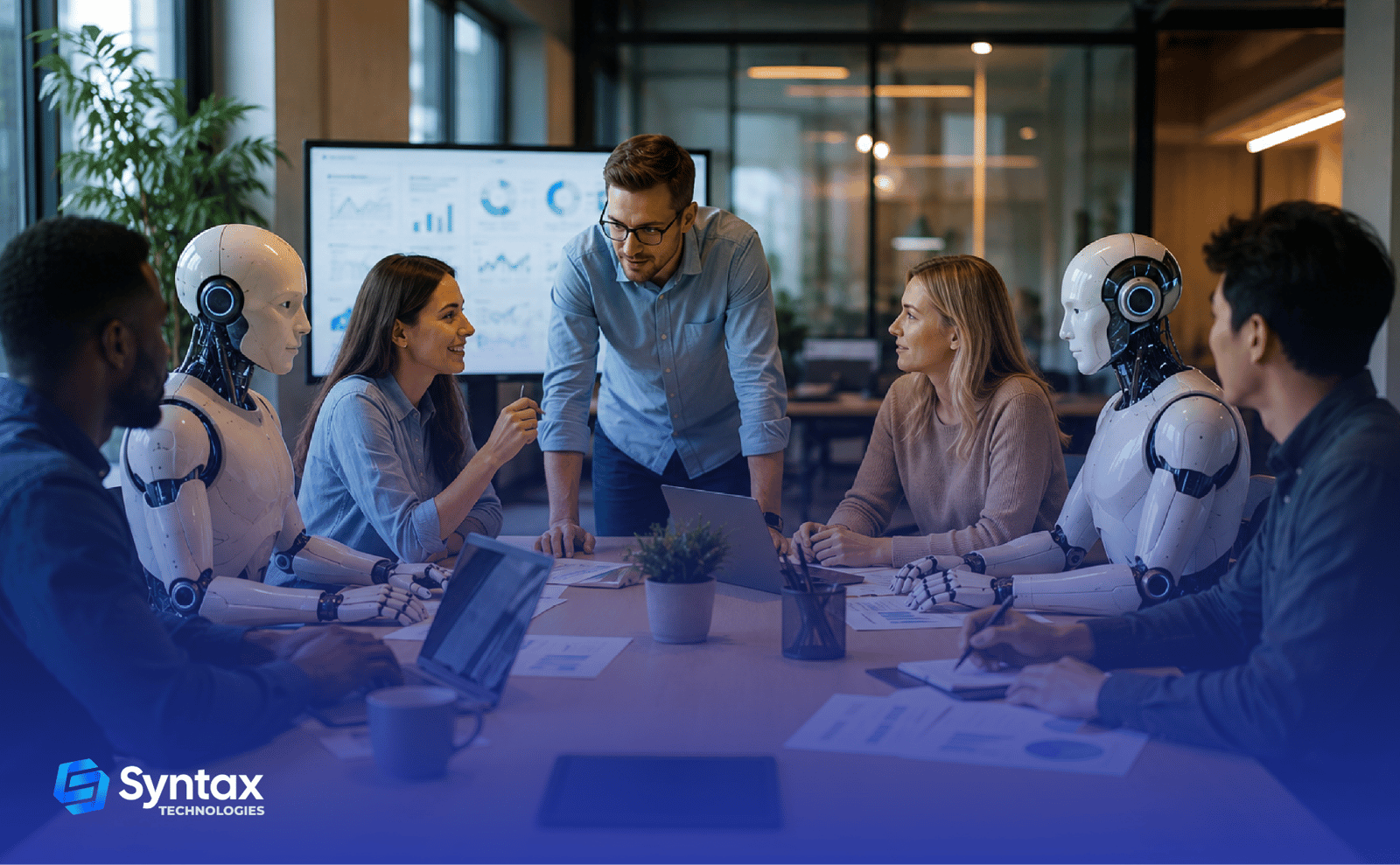
AI Employees Are Coming: What Claude Tells Us About the Future of Work?
What if your next coworker isn’t human?
AI is already moving beyond answering questions and generating drafts. Increasingly capable systems can research, analyze information, write reports, and handle multi-step workflows with less hand-holding.
That changes the bigger question. AI may not replace your entire job—but it could take over a growing share of the work inside it.
Claude offers a glimpse of where this is heading: from AI assistant to something closer to a digital coworker.
So what happens when AI stops being a tool you use and starts doing the work itself?
What Do We Actually Mean by “AI Employees”?
“AI employees” is not a literal job title. AI does not have a salary, employment rights, or a place on the company org chart. It is better understood as shorthand for AI systems that can take responsibility for defined tasks or workflows with varying levels of human supervision.
Think about the evolution:
Software: You tell it exactly what to do.
AI assistant: You ask it a question and get help.
AI agent: You give it a goal, and it can take multiple steps toward completing it.
AI employee: A useful way to imagine an AI system that repeatedly handles a defined area of work, much like a digital coworker.
That last step is where things get interesting.
Anthropic says Claude is increasingly being used for long-running “agentic” tasks through products such as Claude Code and Cowork. Its computer-use capabilities can also let Claude interact with live applications rather than simply responding inside a chat window.
The technology is still developing. But the direction is clear: AI is moving from answering questions to completing work.
What Claude Can Teach Us About Where Work Is Going
Claude offers a glimpse of how AI is moving from answering questions to handling multi-step work.
Instead of simply helping with research or writing, AI systems can increasingly analyze information, create documents, write code, and complete parts of a workflow with less human input.
That changes the question from:
“What can AI help me do?”
to:
“What parts of my work can AI handle?”
That shift—not full job replacement—is what could reshape the workplace.
AI Is More Likely to Change Tasks Than Replace Entire Jobs
Here is the part of the AI and jobs debate that often gets missed: Most jobs are collections of tasks.
Take a marketing professional. Their job might include research, writing, reporting, meetings, strategy, data analysis, and customer communication.
AI could help with the first few tasks without eliminating the entire marketing role.
A sales representative might use AI to research a prospect, summarize recent company news, draft an outreach message, and prepare answers to likely objections. The salesperson still decides whether the opportunity is worth pursuing and handles the relationship.
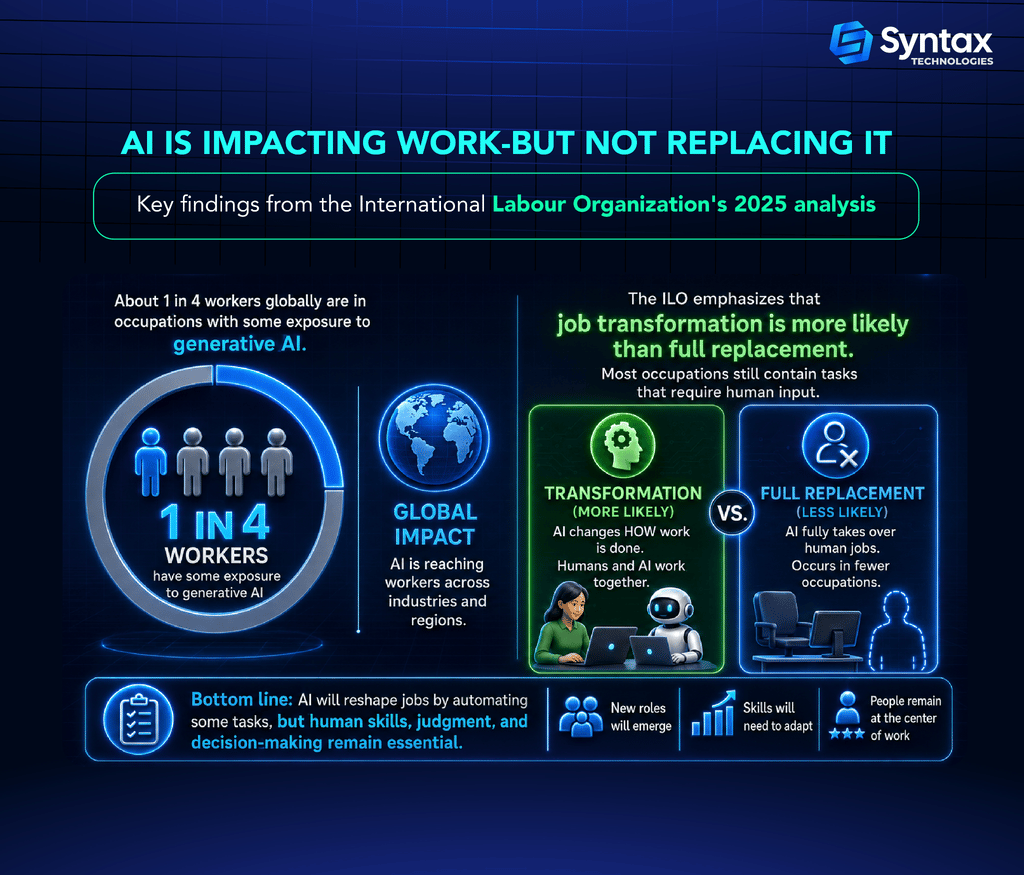
So the better question may not be:
“Will AI replace my job?”
It may be:
“Which parts of my job could AI do, and what would I do with the time that creates?”
The Rise of the One-Person + AI Team
The idea is simple: one person could soon work alongside several AI systems, each handling a different part of the job.
Think of a marketer. Instead of doing every task alone, they could use one AI system to research competitors, another to analyze campaign data, and another to prepare a first draft of a report.
The marketer is still in charge. They set the goals, review the work, make decisions, and decide what happens next.
That is the one-person + AI team: one human directing multiple AI tools that handle parts of the workflow.
A salesperson could use AI to research prospects and prepare outreach. A product manager could use it to organize customer feedback and draft documentation.
The result is not necessarily one person replacing an entire team. But it could allow one professional to get more done without doing every step manually.
That may be one of the biggest changes ahead: not AI replacing people, but people learning how to manage and work alongside their own team of AI assistants.
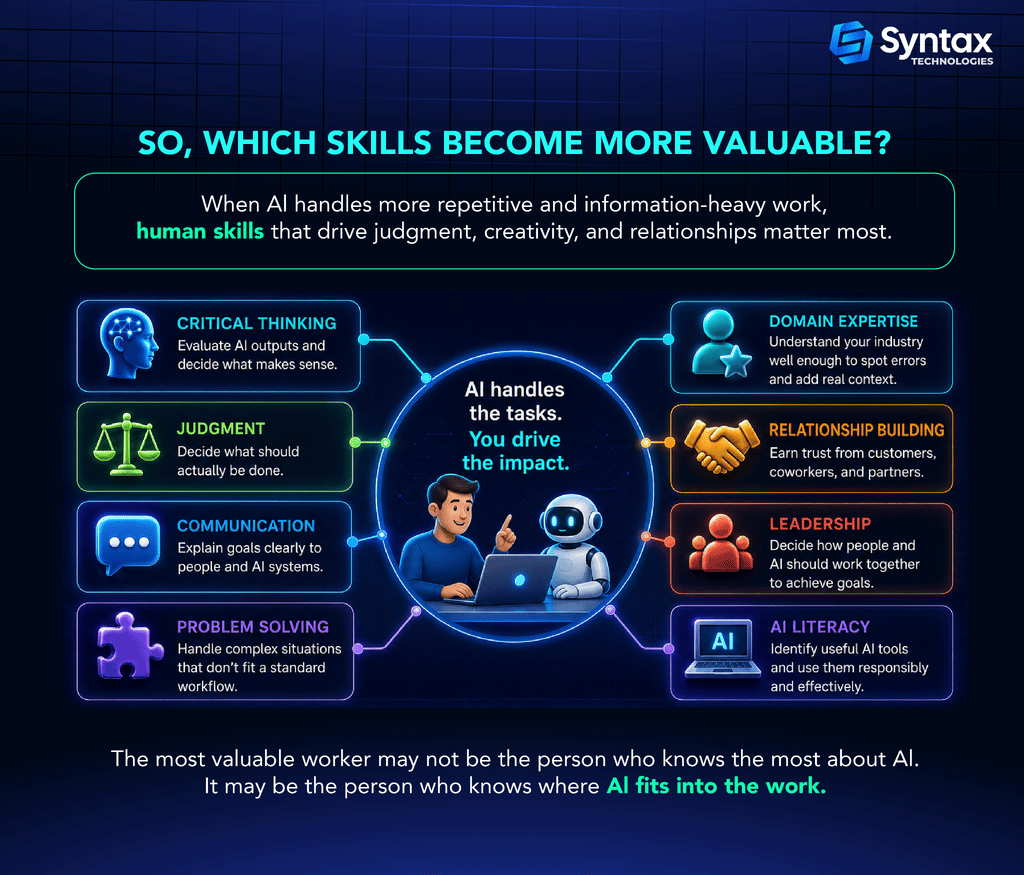
The Real Career Risk May Be Refusing to Adapt
You do not need to become an AI engineer to prepare for an AI-powered workplace. Start with a simple workflow:
1. Learn the tools
Try the AI tools available to you and understand what they can—and cannot—do.
2. Give better instructions
Learn how to clearly explain what you want, provide context, and break complex work into smaller steps.
3. Check the output
Do not assume AI is right because it sounds confident. Review its work, verify important information, and use your judgment.
4. Audit your own work
Look at your daily tasks. Which ones are repetitive, involve gathering information, require a first draft, or take time away from higher-value work?
5. Start small
Choose one or two tasks where AI can help you work faster. Test it, refine the process, and learn what works.
6. Keep the human in charge
Use AI to handle parts of the work, but rely on your judgment for decisions, context, relationships, and accountability.
The goal is not to make yourself unnecessary. It is to become the professional who knows how to combine human judgment with AI capability.
Want to move from simply using AI to building workflows that do real work? Syntax Technologies’ Claude Mastery Fellowship helps you build four practical Claude-powered automations for research, content, operations, and sales—in just four weeks, with no coding background required.
Conclusion
The phrase AI employees are coming sounds dramatic. But the more interesting reality may be much simpler.
AI does not need to replace your entire job to change your career. It only needs to take over enough tasks to change what your job looks like.
The future of work may therefore be less about humans versus AI and more about humans working with AI.
Your next coworker may not have a desk, a résumé, or a coffee mug.
It may be an AI system that handles research, prepares reports, organizes information, or completes a workflow while you focus on decisions, relationships, creativity, and judgment.