


Imagine this: you’ve just started your journey into data analytics. You open a dataset, excited to explore… and suddenly you’re overwhelmed. Which tool should you use? Everyone talks about Pandas, but now there’s a newer name buzzing around—Polars.
So, what’s the deal?
The debate around pandas vs polars for data analysis is becoming more relevant than ever. As data grows bigger and faster, tools are evolving—and choosing the right one can impact your productivity, learning curve, and even career opportunities.
Let’s break it down.

What is Pandas?
Pandas is one of the most popular Python libraries used for data analysis. If you’ve ever worked with Excel, think of Pandas as Excel—but supercharged with Python.
Where is Pandas used?
- Data cleaning and preprocessing
- Data exploration and analysis
- Working with spreadsheets (CSV, Excel files)
- Basic data visualization
Real-world relevance
Pandas has been around for over a decade and is widely used across industries like finance, healthcare, marketing, and tech.
Many companies using pandas for data analysis include startups as well as giants like Netflix, Uber, and Airbnb. It’s often the default tool taught in data analytics courses and bootcamps.
What is Polars?
Polars is a newer data manipulation library designed to be faster and more efficient than Pandas.
It’s built using a modern engine (based on Rust), which allows it to process large datasets much quicker.
Why is Polars gaining attention?
- Faster execution
- Better memory usage
- Designed for modern data workloads
Key differentiator
The biggest highlight in the pandas vs polars performance comparison is speed. Polars can handle large datasets significantly faster, especially when working with millions of rows.
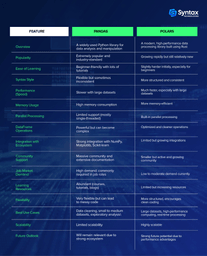
Pandas vs Polars: Key Differences
Let’s compare them in a practical way:
1. Performance (Speed & Memory)
- Pandas: Slower with large datasets, can consume more memory
- Polars: Much faster and more memory-efficient
This is where Polars clearly wins in most pandas vs polars performance comparison discussions.
2. Ease of Use
- Pandas: Beginner-friendly, easier to learn initially
- Polars: Slightly steeper learning curve for beginners
Pandas has simpler syntax and more beginner tutorials available.
3. Ecosystem & Community
- Pandas: Huge community, tons of tutorials, Stack Overflow support
- Polars: Growing but still smaller
This matters a lot when you’re stuck and need help.
4. Scalability
- Pandas: Works well for small to medium datasets
- Polars: Designed for large-scale data processing

Advantages and Disadvantages
Pandas Library Disadvantages
While Pandas is powerful, it’s not perfect:
- Can be slow with large datasets
- High memory usage
- Code can get messy for complex operations
- Limited parallel processing
These are some common pandas library disadvantages that push people to explore alternatives.
Advantages of Polars in Data Analysis
Polars shines in modern data workflows:
- Lightning-fast performance
- Better memory efficiency
- Supports parallel processing
- Cleaner and more optimized queries
These are key advantages of polars in data analysis, especially when working with big data.
Industry Perspective
Companies Using Pandas for Data Analysis
Pandas is still the industry standard. Many organizations rely on it for everyday analytics tasks. If you’re applying for entry-level roles, chances are high that Pandas will be expected.
Is Polars Accepted in Data Analyst Roles?
Right now, is polars accepted in data analyst roles? The answer is: not everywhere yet.
Most job descriptions still mention Pandas. However, Polars is gaining traction, especially in data engineering and performance-heavy environments.
If you’re just starting out, learning Pandas through a structured path can make things much easier. In the Data Analytics program by Syntax Technologies, Python and Pandas are taught with practical, real-world use cases to help you build confidence step by step.
Polars Adoption in Industry
The polars adoption in industry is growing steadily. Tech-savvy teams and companies dealing with large datasets are starting to experiment with it. While it’s not mainstream yet, its future looks promising.
Conclusion
So, what’s the final takeaway in the pandas vs polars for data analysis debate?
- Pandas is your starting point—reliable, beginner-friendly, and widely used
- Polars is the future—fast, efficient, and built for scale
If you’re just getting started, don’t overthink it. Begin with Pandas, build your foundation, and then gradually explore Polars as you grow.
The goal isn’t to pick one forever—it’s to become adaptable.