
How to Break Into AI Product Management: 2026?

If you’ve been scrolling through LinkedIn lately, you’ve probably noticed something:
AI jobs are everywhere. And among them, AI Product Management is quickly becoming one of the hottest career paths for 2026.
Companies of all sizes—from startups to the world’s biggest tech giants—are building AI-powered products faster than ever. And they need people who can connect the dots between technology, customers, and business goals.
That’s exactly where AI Product Managers come in.
If you’re curious about this role, want to transition into tech, or simply want to future-proof your career, this guide will walk you through everything you need to know.

What Is AI Product Management?
AI Product Management is the practice of building products that use Artificial Intelligence to solve problems for users. Think of it as traditional product management—but with an added layer of working with data, models, and intelligent systems.
At its core, AI Product Management means:
- Understanding a real customer problem
- Figuring out how AI can (or cannot) help
- Working with data scientists, engineers, and designers to build the solution
- Making sure the AI product is useful, safe, and aligned with user needs
Unlike regular apps, AI products don’t always behave the same way every time because they rely on data-driven models. So AI Product Managers focus on things like model performance, data quality, prompts, user feedback loops, and ethical considerations—while still owning the business goals and product roadmap.
Why AI Product Management Is Booming in 2026
2026 is a turning point for AI adoption. What felt experimental two years ago is now mainstream.
Here’s why AI Product Managers are in massive demand:
1. Every product is becoming an AI product
From banking and healthcare apps to logistics platforms and customer service tools, AI is now a core part of product strategy. Companies need people who understand how to integrate AI responsibly.
2. The rise of foundation models and copilots
Thanks to advanced models from OpenAI, Google, Anthropic, and others, businesses can build AI features without huge engineering teams. This has opened the floodgates—more companies need product leaders who can guide these AI initiatives.
3. Market growth is exploding
Reports consistently show double-digit growth in AI investment year over year. The global AI market is expected to cross hundreds of billions by 2030, and companies are already hiring ahead of that curve.
4. New AI use cases appear every month
Think:
- AI agents
- Personalized shopping
- Healthcare diagnostics
- Fraud detection
- Language translation
- Autonomous operations
The industry needs professionals who can ask: “What’s useful, what’s safe, and what’s actually worth building?”
This is exactly why AI Product Management is one of the fastest-rising roles for 2026.
What Skills You Need to Break Into AI Product Management
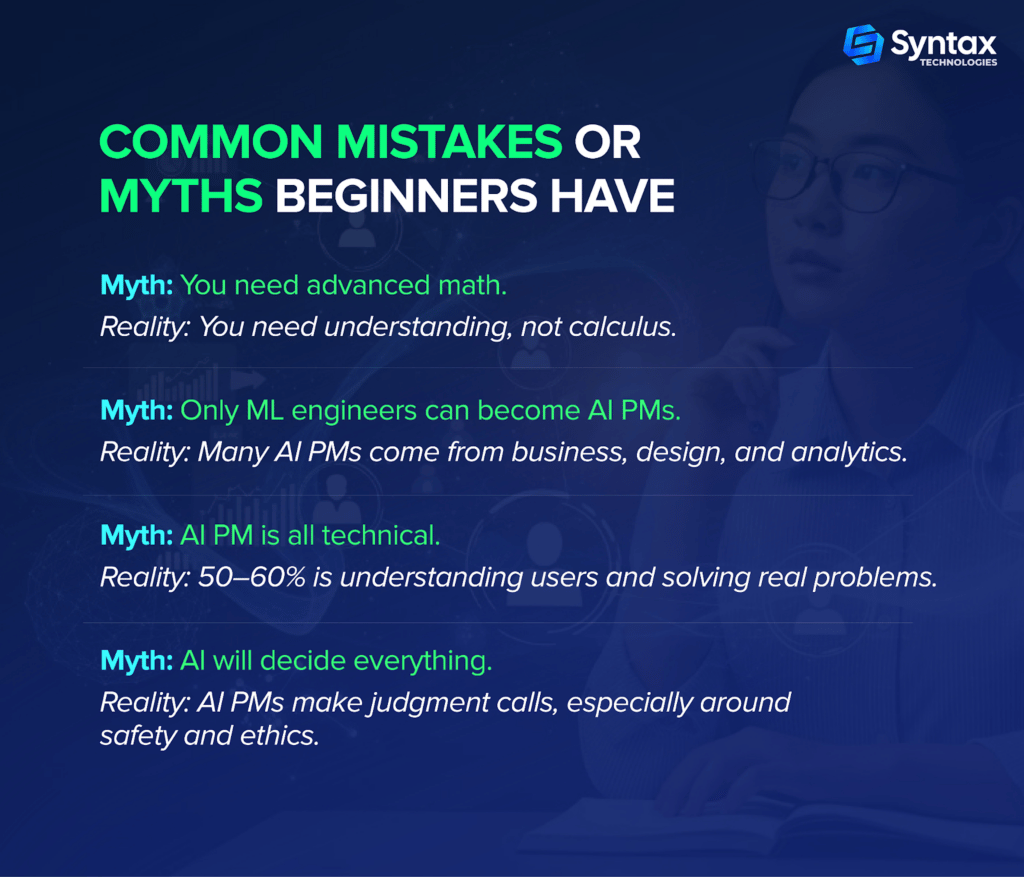
The good news? You don’t need to be an ML engineer.
But you do need a blend of technical understanding and product instincts.
Technical Skills
You don’t need to code models—but understanding the basics helps you work with technical teams.
- AI fundamentals: How models work, what training means, limitations of AI
- Data literacy: What “good data” is, bias, accuracy, metrics
- Prompting basics: How prompts influence LLM outputs
- AI ethics and safety: Fairness, privacy, responsible AI
Non-Technical Skills
- Product sense: Can you identify what users actually need?
- Communication: You’ll be talking to engineers, designers, marketers, customers.
- Experimentation mindset: AI requires testing, iteration, feedback loops.
- Prioritization: Not all features should be built—AI PMs decide what matters most.
- Problem-solving: AI can’t fix everything. You should know when NOT to use AI.
Step-by-Step Guide to Entering AI Product Management
1. Learn the Fundamentals (2–3 months)
Start with:
- Basics of product management
- Basics of AI and machine learning
- Understanding LLMs and generative AI
- Data fundamentals
2. Build a Small Portfolio
Create 2–3 simple AI product case studies. For example:
- Redesigning a customer service workflow using AI
- Designing an AI-powered study assistant
- Improving an e-commerce app using AI recommendations
Your portfolio should show your thinking, not your coding.
3. Play with AI Tools
Use:
- ChatGPT
- Claude
- Gemini
- Midjourney
- No-code AI builder tools
4. Network With AI PMs
Simple places to start:
- Product and AI Slack communities
- AI-focused meetups
- Edtech and upskilling communities
5. Apply for Entry-Level or Transition Roles
Not all roles say “AI Product Manager.” Look for:
- Associate Product Manager (APM)
- AI Analyst
- Product Analyst
- Prompt Engineer
- AI Strategist or AI Associate
- Data Product Manager
These roles often lead to AI PM within 1–2 years.
Conclusion
Breaking into AI Product Management in 2026 isn’t just possible—it’s one of the smartest, most future-proof career moves you can make. The field is growing rapidly, the opportunities are diverse, and the work sits at the intersection of creativity, strategy, and cutting-edge technology.
You don’t need to be a coding expert. You don’t need a math degree.
What you do need is curiosity, structured learning, and the confidence to start experimenting.
And if you want a guided, beginner-friendly way to accelerate your journey, the AI Product Management course by Syntax Technologies is a great place to start. It’s designed for people who are new to the field—covering everything from AI fundamentals to hands-on product thinking, real project work, and job-ready skills.