


If you’ve been browsing analytics job descriptions, you’ve probably noticed one confusing phrase popping up again and again: “business thinking required.”
And if you’re like most aspiring analysts, you’ve probably wondered — what does that even mean?
You already know SQL, Python, Excel… maybe even some dashboards. But suddenly, companies are asking for something that feels vague and undefined.
Here’s the truth: business thinking in analytics jobs isn’t about knowing fancy business jargon. It’s about understanding why your analysis matters and how it helps a company make better decisions.
Let’s break it down in a simple, practical way.

What is Business Thinking in Data Analytics?
At its core, what is business thinking in data analytics?
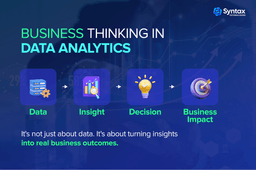
It’s the ability to connect data insights to real business outcomes.
Instead of just analyzing numbers, you ask:
- What problem are we solving?
- Why does this matter to the company?
- What action should be taken based on this data?
Simple Example:
Let’s say you analyze website traffic and find that visits dropped by 20%.
A technical analyst might stop there.
A business-minded analyst would ask:
- Did this impact revenue?
- Which customer segment dropped?
- Is this due to marketing changes or seasonality?
- What should we do next?
That’s the difference.
Business thinking = turning data into decisions.

Why Employers Want Business Thinking in Analytics Candidates
Companies don’t hire analysts just to create reports. They hire them to:
- Increase revenue
- Reduce costs
- Improve customer experience
That’s why “why employers want business thinking in analytics candidates” is simple: impact matters more than analysis.
Real-World Scenario
Imagine two analysts:
Analyst A:
- Builds a dashboard showing customer churn
Analyst B:
- Identifies why customers are leaving
- Suggests a retention strategy
- Estimates revenue saved
Who do you think adds more value?
Key Insight
The importance of business thinking in analytics careers is huge because:
- It makes your work actionable
- It helps leadership trust your insights
- It positions you as a decision-maker, not just a data worker

Think of it like this:
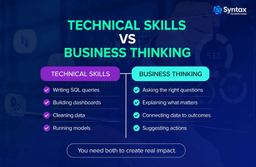
Technical skills = knowing how to cook
Business thinking = knowing what to cook and why
You can have amazing technical skills, but without direction, they don’t create impact.
That’s why business thinking vs technical skills in analytics isn’t a competition — you need both.
How to Develop Business Thinking for Analytics
Here’s how you can start.
1. Ask Better Questions
Instead of:
“What does the data say?”
Ask:
“Why does this matter?”
“What decision will this support?”
2. Understand Business Goals
Every company cares about:
- Revenue
- Costs
- Growth
- Customer satisfaction
If you align your analysis with these, you’re already thinking like a business analyst.
3. Learn Basic Business Concepts
You don’t need deep finance knowledge, but understanding helps:
- Profit vs revenue
- Customer lifetime value
- Conversion rates
4. Practice Case-Based Thinking
Try this:
- Pick a company (e.g., e-commerce)
- Ask: How can they increase sales?
- Use data to support ideas
5. Think in Terms of Impact
Always end your analysis with:
- “So what?”
- “What should we do next?”
That’s how to develop business acumen for data analysts in a practical way.
How to Showcase Business Thinking in Analytics Interviews
Now comes the big question: how do you prove this skill?
1. On Your Resume
Don’t just say:
“Created dashboard”
Say:
“Built dashboard that identified 15% drop in retention, leading to improved customer engagement strategy”
2. While Explaining Projects
Structure your answers like this:
- Problem
- Analysis
- Insight
- Business impact
3. In Interview Questions
When asked about a project:
- Talk about decisions, not just data
- Mention stakeholders
- Highlight outcomes
4. Use Business Language
Instead of:
“I analyzed data”
Say:
“I helped the team understand why revenue dropped and suggested improvements”
This is exactly how to showcase business thinking in analytics interviews and stand out from other candidates.
If you’re aiming to grow in analytics, it’s not just about mastering tools—it’s about learning how to think, solve, and communicate like a business professional. Structured learning can bridge that gap by helping you connect data with real-world decisions and outcomes.
For instance, the Data Analytics course offered by Syntax Technologies, focuses on blending technical skills with practical business understanding, so you’re not just job-ready on paper, but capable of driving meaningful impact from day one.
Conclusion
Business thinking in analytics jobs isn’t complicated — it’s practical.
It’s about:
- Understanding the problem
- Connecting data to decisions
- Driving real-world impact
Once you shift your mindset from “analyzing data” to “solving business problems,” everything changes.