
AI Product Management Certificate vs Traditional PM Certificates

Is the old-school Product Management certificate still relevant in today’s AI-driven world?
If these questions have been circling your mind, you’re not alone. Thousands of professionals—especially those trying to move into product careers—are confused about whether they need a traditional Product Management (PM) certificate or a new-age AI Product Management certificate.
With AI reshaping industries, creating new job titles, and changing how products are built, this confusion is real. This blog will break everything down simply so you can confidently decide what’s right for your career.
A traditional PM certificate teaches the foundations of building and managing products in any industry—tech or non-tech.
It typically covers:
- Product strategy and vision
- Market and competitor research
- User interviews and customer insights
- Roadmap creation
- Feature prioritization
- Go-to-market planning
- Cross-functional collaboration
- Product lifecycle management
- Stakeholder communication
Traditional PM programs prepare you for roles like:
- Product Manager
- Associate Product Manager
- Product Owner
- Business Analyst (product-focused)
These roles focus on understanding customer problems, translating them into features, and working with design and engineering teams to deliver solutions. The work is structured, predictable, and follows well-established frameworks.
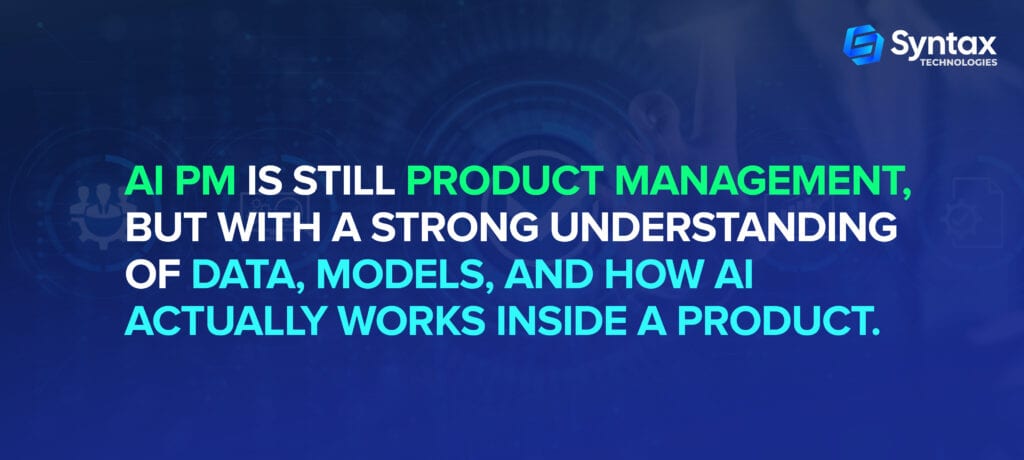
What Is an AI Product Management Certificate?AI Product Management is an evolution of traditional PM—built for a world where products increasingly use machine learning (ML), automation, and data-driven intelligence.
AI PM programs usually include:
- Basics of AI, machine learning, and data science
- Data literacy: how data is collected, cleaned, and used
- Understanding how ML models work (without needing coding skills)
- AI product lifecycle (from problem framing to model monitoring)
- AI-driven decision-making
- Prompt engineering and LLM-based feature design
- Ethical AI principles: fairness, privacy, responsible use
- Working with data scientists, ML engineers, and research teams
AI PM roles include:
- AI Product Manager
- ML Product Manager
- Applied AI Product Manager
- LLM/GenAI Product Manager
These roles focus on building intelligent features—for example:
- Personalized recommendations
- Fraud detection systems
- Chatbots and AI assistants
- Predictive suggestions and Automated workflows
- GenAI content tools
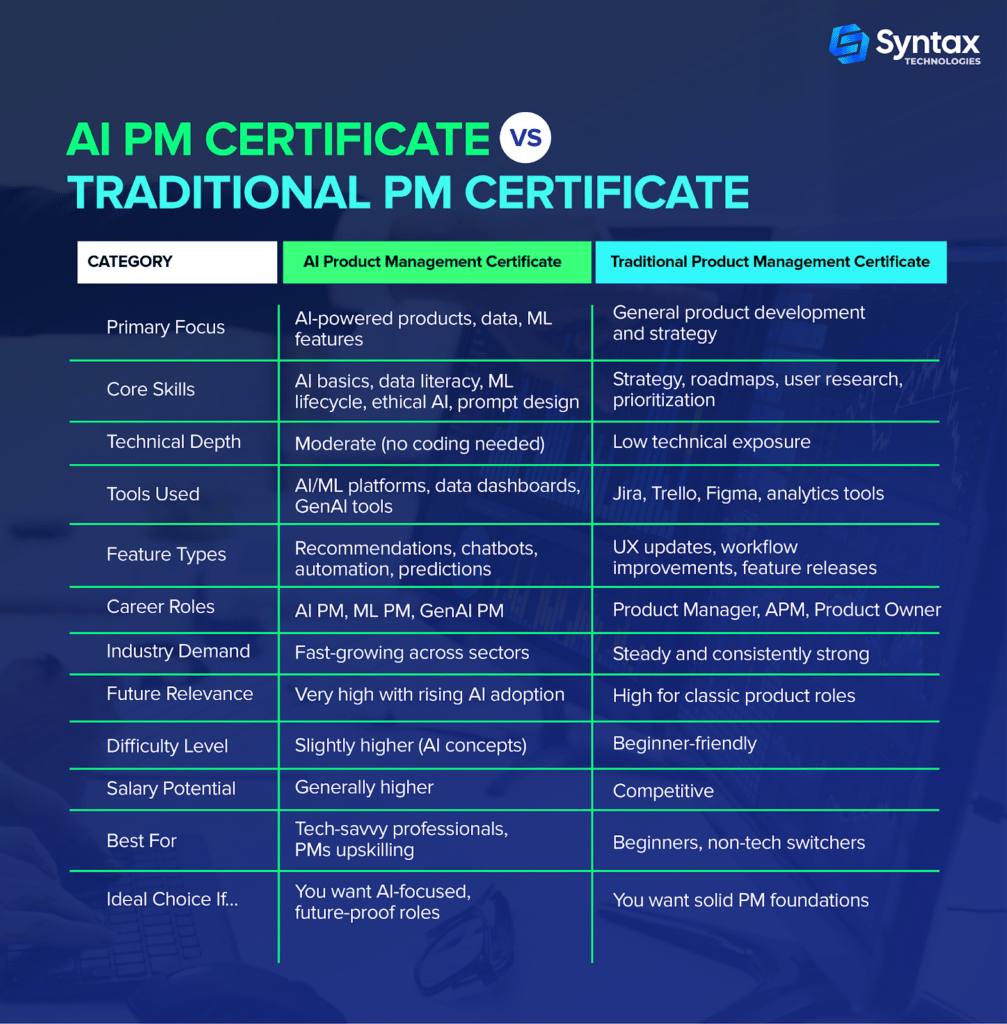
1. Skills Taught
Traditional PM: Strategy, roadmaps, user research, feature prioritization.
AI PM: AI fundamentals, data literacy, ML lifecycle, evaluation metrics, prompt engineering, responsible AI.
2. Tools and Technologies
Traditional PM: Jira, Trello, Figma, analytics tools, user research tools.
AI PM: ML platforms, data tools, model monitoring dashboards, GenAI tools, experimentation frameworks.
3. What You’ll Work On
Traditional PM: User-facing features (e.g., new homepage layout, checkout flow improvements).
AI PM: Intelligent features (e.g., personalized ranking, AI chatbots, anomaly detection).
4. Industry Demand
Traditional PM roles are still valuable, but AI PM roles are growing faster because companies are adding AI features to almost everything—from HR software to dating apps.
5. Future Relevance
Traditional PM will always exist.
But AI PM is expected to see massive growth as more products rely on automation and data-driven intelligence.
6. Difficulty Level
Traditional PM is easier for complete beginners.
AI PM has a learning curve—but you don’t need coding or math if the program teaches it well.
7. Salary Potential
Most companies pay AI PMs slightly higher because the role sits at the intersection of product, data, and engineering.
Choose a Traditional PM Certificate if:
- You want foundational product skills
- You’re moving from non-tech roles like marketing, sales, or operations
- You want to work in industries where AI adoption is still slow
- You prefer working on UX, customer research, and feature planning
Best for: Beginners, career switchers, and people wanting classic PM roles.
Choose an AI Product Management Certificate if:
- You want to work in tech, SaaS, or fast-growing AI-first companies
- You’re curious about how AI systems are buil
- You want higher-paying, future-proof product roles
- Your job or industry is already adopting AI-driven features
- You want to collaborate with data scientists and ML engineers
Best for: Tech professionals, business analysts, data enthusiasts, PMs wanting to upgrade.
If You’re a Beginner:
Start with traditional PM concepts → then add AI PM skills. This combination is incredibly powerful.
If You’re Non-Technical:
AI PM is very doable as long as the program breaks down concepts without coding or math. Choose a course that teaches AI fundamentals in plain English.
If You’re Already in Tech:
AI PM will boost your career dramatically because companies prefer PMs who understand how ML-powered features work.
Final RecommendationBoth certificates are valuable—it’s not a competition.
Traditional PM certificates give you strong foundations.
AI PM certificates give you future-ready skills.
But here’s the truth: AI is becoming part of almost every product, and the demand for AI Product Managers is growing faster than traditional PM roles. If you want to stay competitive in the next 5 years, having at least some AI product knowledge is no longer optional—it’s a career advantage.
If you’re exploring this path and want clear, beginner-friendly guidance, take a look at the AI Product Management course by Syntax Technologies. It’s designed for non-technical learners and focuses on real, industry-ready AI product skills that companies value today.